
Camperdown Terrace- Contemporary Home in Sydney’s Inner West


Camperdown Courtyard
A new terrace in a conservation zone ticks all the boxes.
Camperdown Terrace – Contemporary Home in Sydney’s Inner West
Building a contemporary home within a heritage conservation area is a challenging and delicate task. This challenge grew even greater for our Camperdown project, located among a row of original Victorian terraces. The site’s unique “infill” position required a design that respected its heritage context while meeting the needs of modern family living.
At PWA, we developed a contemporary family home that honors the locality’s heritage values and delivers exceptional environmental performance.
A Home and Office Designed for Its Surroundings
The house’s form responds carefully to its historic context. Given the rich heritage of neighboring Victorian townhouses, it was essential that the new building incorporate key architectural features from this era.
What makes this project unique is how it balances tradition and modernity. While the materials and design ideas are contemporary, the house maintains a clear connection to its historic neighbors. Following the principles of the Burra Charter, the design respectfully references the past while confidently asserting its newness.
Façade Design: Respecting Tradition with a Modern Twist
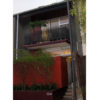
The façade blends distinctive style with harmony to the adjoining Victorian terrace. The stepped roof form echoes the neighboring higher house, aligning the building with the established street pattern.
The traditional second-level balcony remains a key feature, echoing the street’s rhythm. This balcony uses a modern cantilever support and features a sleek steel handrail that subtly references the intricate wrought iron filigree of nearby homes.
Interior Design: Addressing Victorian Challenges with Innovation
Inside, we faced different challenges. Typical Victorian houses often suffer from poor circulation, limited daylight, and inadequate air movement. We reimagined the interior layout to create spacious living areas and a functional kitchen.
Rather than clearing the structure entirely with long-span frames—which can lead to storage and circulation issues—we embraced the building’s structural elements. Short masonry block nibs support the first-floor slab, creating open central spaces while dividing the sides into useful bays for staircases and storage.
Unconventional Living Spaces for Practical Benefits
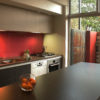
The kitchen and main living areas are located at the front of the ground floor, an unconventional but deliberate choice. Placing these spaces on the ground floor ensures they receive ample natural light and avoids overshadowing the lower levels or neighboring buildings.
Positioned near the front door, the kitchen doubles as a welcoming “café-style” reception area for guests and clients, creating a warm introduction before entering the rest of the home.
Connecting to Nature: The Central Courtyard
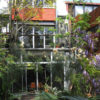
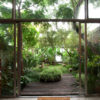
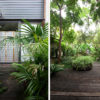
A striking feature of the property is its large central courtyard, abundant with native plants and inspired by Japanese garden design. This green space visually links the main house with a separate home office at the rear, while maintaining a pleasant natural separation.
A Prototype for Medium-Density Urban Living
This project exemplifies how to balance heritage conservation, environmental performance, and clever design in a medium-density urban setting. Although recently built, the house feels perfectly at home within its historic surroundings.
PWA proudly calls this innovative family home our own.